Understanding how ocean waves form makes the ocean feel less mysterious and far more interesting.
Waves can look simple from shore, but they result from energy moving through water in different ways. Some are created by wind, some by underwater disturbances, and some are shaped dramatically by the coastline they approach.
The water itself often moves less than people think, while the energy travels across the surface and transforms as conditions change.
Wind Creates Most Surface Waves
The majority of everyday waves begin with wind blowing across the water. As air moves over the surface, friction transfers energy into the water.
Small ripples form first. If the wind continues at sufficient speed, over sufficient distance and time, those ripples can grow into larger waves.
This is why storm systems far offshore can create surf many miles away from where the wind originally blew.
See The Real Reason Ice Floats for another water science explainer.
What Water Particles Actually Do
Many people imagine a wave as a wall of water traveling forward across the sea. In reality, the energy moves forward more than the water itself.
Water particles often move in circular or orbital patterns as the wave passes. They rise, move slightly, fall, and return.
That is why floating objects may bob up and down without traveling as far as the wave seems to move.
Why Some Waves Get Bigger
Three major factors help determine wave size: wind speed, wind duration, and fetch. Fetch is the distance the wind blows across open water.
Stronger wind adds more energy. Longer-lasting wind keeps building the wave. Greater fetch gives the wave room to grow.
That is why huge open-water systems can produce larger waves than small sheltered bays.
What Happens Near Shore
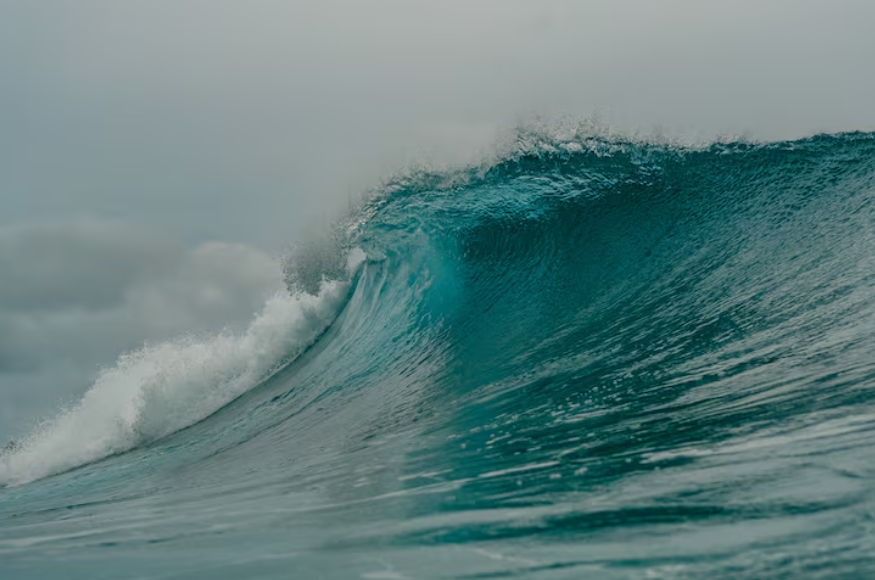
As waves enter shallower water, the lower part of the wave begins interacting with the seabed. Friction slows the base of the wave while the top continues moving.
This causes the wave to steepen and eventually break. That familiar crashing shape is a shallow-water transformation, not how the wave looked offshore.
Different bottoms, sandbars, reefs, and slopes can change how and where waves break.
Read The Science Behind Rip Currents for more coastal water movement.
Swell vs Local Chop
Not all waves feel the same. Long, smooth swells often come from distant weather systems and can travel great distances across the ocean.
A short, messy chop is usually generated by nearby wind and tends to feel more chaotic.
Surfers, boaters, and swimmers often care deeply about this difference because it affects comfort and safety.
What About Tides?
Tides are not the same as waves. Tides are large-scale rises and falls in sea level caused mainly by gravitational interactions involving the moon and sun.
However, tides can influence how waves behave near shore by changing water depth over reefs, bars, and beaches.
So tides do not create normal wind waves, but they can shape the final experience.
Tsunamis Are Different Too
Tsunamis are not regular surf waves. They are usually caused by underwater earthquakes, landslides, or volcanic activity that displace large volumes of water.
Their energy moves through the full depth of the ocean, which is why they behave differently and become so dangerous near shore.
They belong to a separate category from everyday beach waves.
Explore How Tsunamis Really Work for a clearer look at tsunami behavior.
Why Waves Matter
Waves shape coastlines, move sand, influence marine habitats, and create recreation from surfing to sailing.
They also carry risk through erosion, strong surf, and changing currents. Knowing how they form helps people make smarter decisions around water.
Even standing on shore becomes more interesting when you understand what you are watching.
Waves actually form when energy meets water and then meets geography. What looks like a simple motion is really weather, physics, and the shape of the Earth working together in plain sight.
Check Why Water Pressure Can Crush You for another related explainer.