The deep sea is not a barren void. It is one of Earth’s strangest and least understood ecosystems.
The deepest parts of the ocean seem like they should be empty. They are cold, dark, under crushing pressure, and far beyond the reach of sunlight. Yet life exists there, including deep-sea creatures.
In trenches and abyssal zones thousands of feet below the surface, animals and microbes have evolved to survive conditions that would destroy most surface organisms.
The Environment Down There
Sunlight disappears surprisingly quickly in the ocean, and the deepest regions are permanently dark. Temperatures are low, food can be scarce, and pressure increases dramatically with depth.
These conditions shape every aspect of deep-sea life. Organisms must conserve energy, find food efficiently, and tolerate extreme environments.
What looks hostile to us becomes normal for species that evolved there.
Read Why Water Pressure Can Crush You for more context on deep-ocean force.
Deep-Sea Fish
Some of the most famous trench and deep-water animals are unusual fish with large mouths, expandable stomachs, or glowing features. Anglerfish and viperfish are iconic examples from deeper zones, though not always the very deepest trenches.
Many deep-sea fish are built for rare feeding opportunities. If prey appears, they need to take advantage of it quickly.
Bioluminescence can help attract prey, communicate, or confuse predators in total darkness.
Giant Amphipods and Crustaceans
Crustaceans thrive in deep environments. Amphipods, shrimp-like scavengers, are common in trenches where they feed on sinking organic material.
Some species grow surprisingly large compared with shallow-water relatives. This phenomenon, sometimes called deep-sea gigantism, appears in several ocean groups.
Scavengers play an important role by recycling material that drifts down from above.
Explore Why Bioluminescence Happens in Water to understand how light works underwater.
Strange Invertebrates
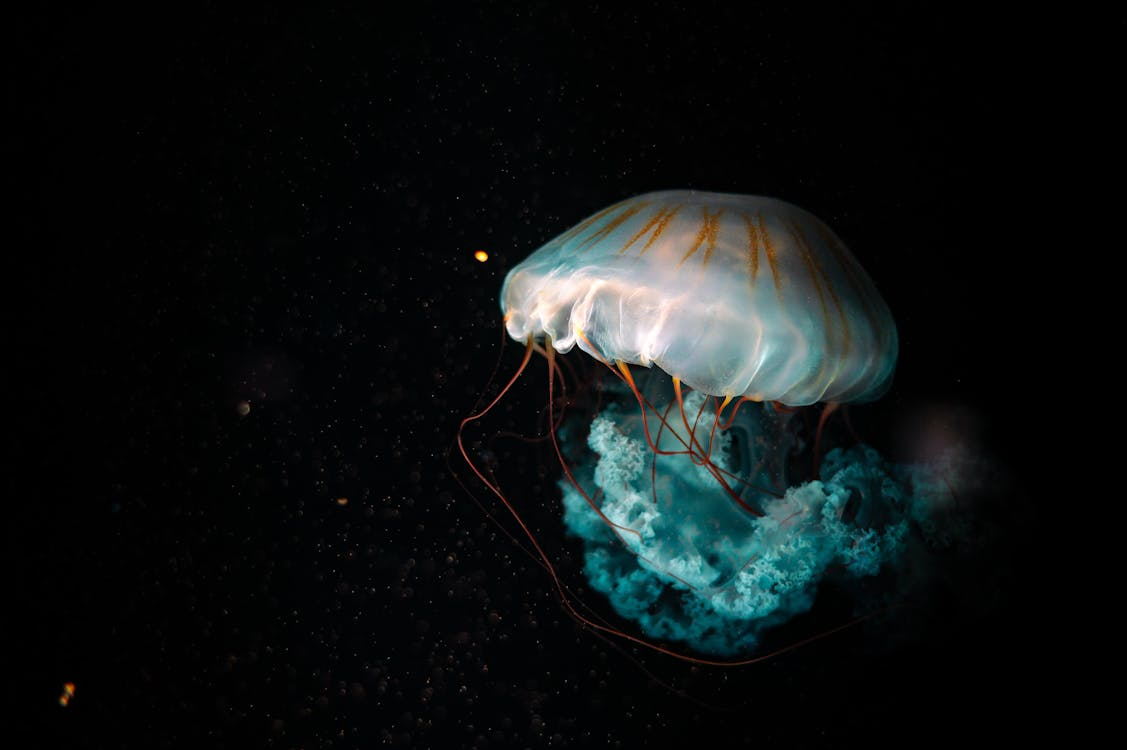
Sea cucumbers, worms, brittle stars, and jelly-like organisms inhabit many deep regions. They may not look dramatic at first glance, but they are essential parts of the ecosystem.
Some filter particles from the water, while others graze on organic matter in sediments.
The deep sea depends heavily on these quieter life forms, not only headline creatures with sharp teeth.
Microbial Life and Chemical Survival
Microbes may be the most important deep-ocean residents of all. In some environments, especially near hydrothermal vents, microorganisms use chemicals rather than sunlight as the base of food webs.
This process, called chemosynthesis, supports communities that include tube worms, clams, and other specialized animals.
It expands our understanding of where life can exist on Earth and possibly beyond it.
How Animals Survive the Pressure
Deep-sea creatures are not simply tougher versions of shallow animals. Their bodies are adapted at the cellular and structural levels for high pressure.
Many have softer bodies, reduced skeletal structures, and specialized chemistry that helps proteins function under stress.
The lesson is not brute strength, but elegant adaptation.
See Bioluminescent Bays That Glow at Night for another look at glowing marine life.
Why We Still Know So Little
The deep ocean is hard and expensive to study. Specialized submersibles, robotics, and research missions are required to reach the most extreme depths.
Because exploration is limited, new species are still being discovered regularly. Many areas remain barely observed.
We know more about some distant planets than our own ocean floor.
Check What Happens to Your Body After Hours in Water for more water science.
Why It Matters
Deep-sea ecosystems influence global nutrient cycles, carbon storage, and biodiversity. They are also vulnerable to pollution, climate change, and future resource extraction.
Studying them helps science, conservation, and our broader understanding of life itself.
Mystery does not mean irrelevance. Hidden systems can still be essential systems.
What lives in the deepest parts of the ocean is not one monster or one miracle. It is an entire world of specialized life, thriving where darkness, pressure, and distance once made us assume nothing could survive.